


 ()


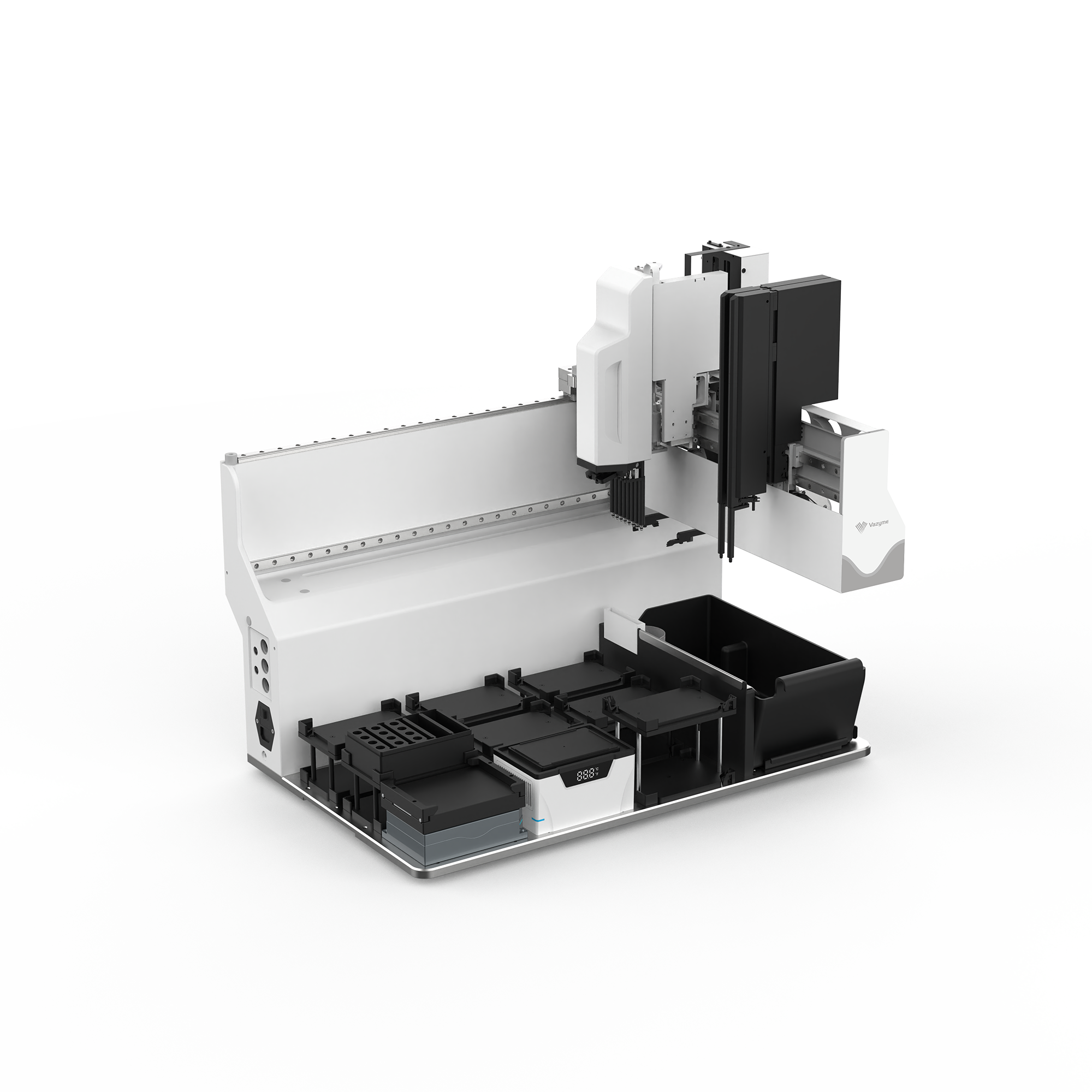
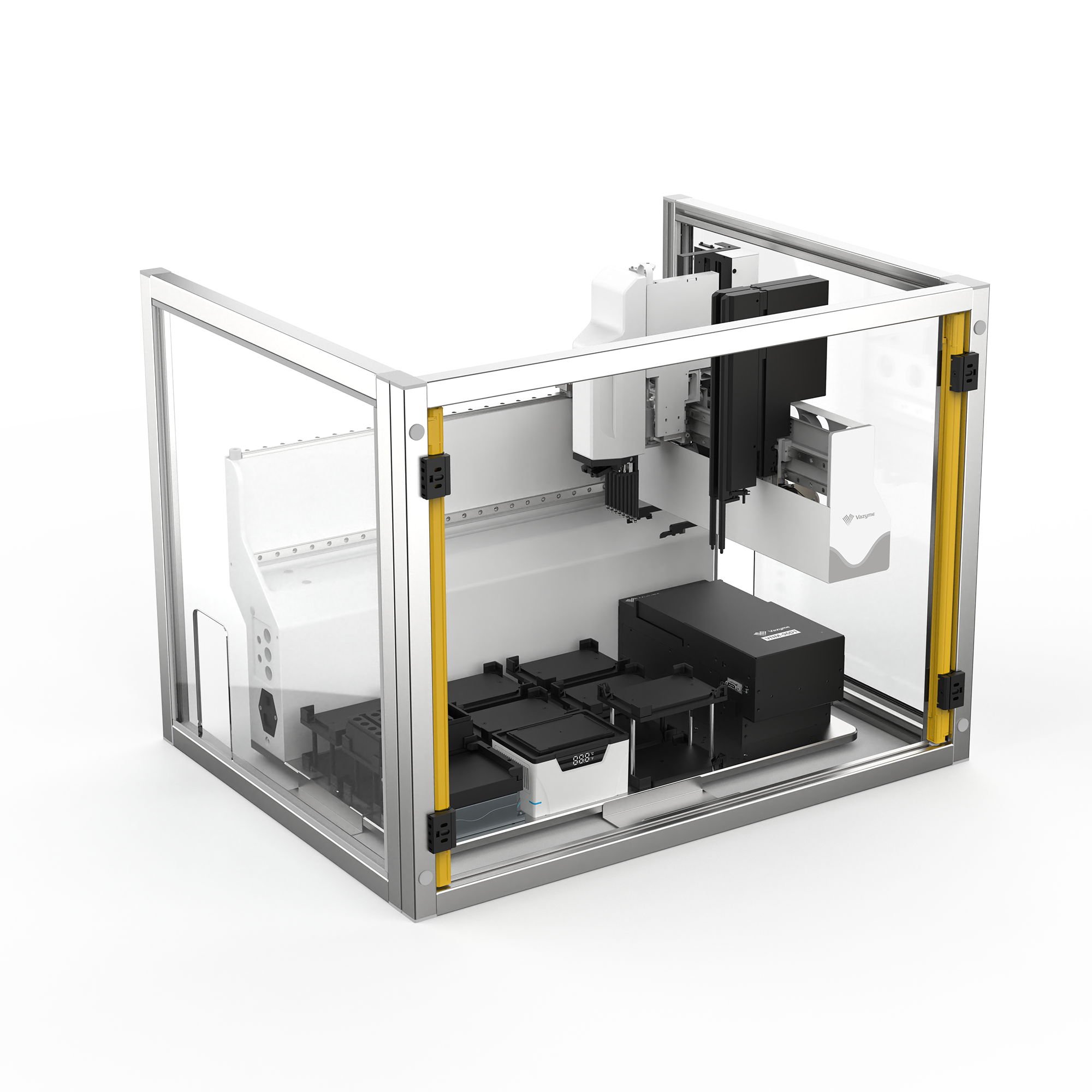
PANDA Mini Liquid Handling Workstation
Product Detail
Why Automate Liquid Handling?
Manual pipetting can introduce variability, consume valuable laboratory time and reduce throughput.
PANDA Mini helps laboratories standardize workflows, improve reproducibility, and automate repetitive liquid handling—from PCR/qPCR setup to the last mile of NGS, including automated quantification, normalization, and pooling.
Why Choose PANDA Mini?
Compact Design Reliable Pipetting
Suitable for laboratories with limited bench space. Improve consistency and reduce manual errors.
Flexible Applications Simple Workflow
Support PCR/qPCR set up, NGS workflow. Reduce hands-on time and improve laboratory productivity.
 Product Description
Equipped with a fixed 8-channel pipettor and two flexible-channel pipettors, the PANDA Mini supports sample normalization and pooling in the full automation workflow, acting as a bridge between extraction, library preparation, and sequencing. It is designed to reliably handle routine high-throughput workflows and liquid handling tasks, reducing human error, accelerating experimental time, and simplifying operations through touchscreen interface.
 Features
35-Second Quantification
Powered by EAGLE · Up to 96 samples
Integrated with EAGLE fluorescence quantification technology, enabling rapid signal detection and automated analysis of up to 96 samples within 35 seconds.Hands-Off Automation
Automated Pipetting · Normalization · Pooling
Combining fixed 8-channel and flexible 2-channel pipetting capabilities, PANDA MINI automates a wide range of laboratory liquid handling tasks, from sample transfer to Anormalization and pooling, reducing manual workload.Reliable Results
Consistent. Accurate. Reproducible
PANDA MINI delivers reliable and reproducible results through precise pipetting, automated quantification, and intelligent volume adjustment.
 Storage
: 19–25°C
Transportation: Room temperature
Performance
How PANDA MINI Works
Integrated Automation for Reliable Molecular Workflows
PANDA MINI combines automated liquid handling, integrated quantification, and intelligent workflow control to simplify sample preparation for PCR, qPCR, and NGS applications.Intuitive Software Control
Visual workflow programming with one-click execution simplifies operation and enables consistent automated workflows.Performance:
Visual protocol setup
One-click workflow execution
Reduced manual intervention
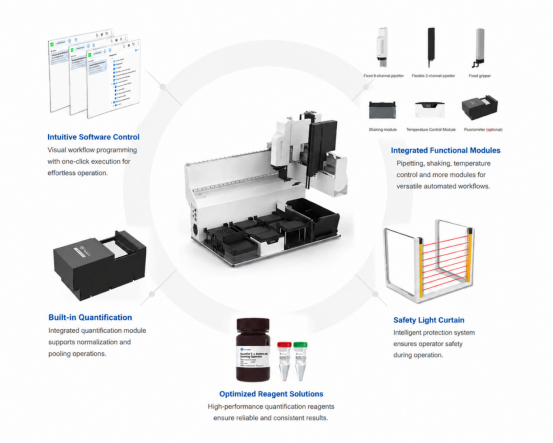
Optimized Reagent Solutions
High-performance reagents combined with automated workflows ensure accurate and reproducible molecular analysis.Performance:
Dedicated quantification reagents
Consistent assay performance
Reliable experimental results
Simplified workflow integration
Optional Safety Light Curtain
Intelligent protection design ensures safe and reliable operation during automated processing.Performance:
Operator protection during operation
Automatic safety monitoring
Enhanced laboratory safety
Applications
Why Researchers Choose PANDA Mini
Manual Pipetting | PANDA Mini |
Time-consuming | Automated Workflow |
Manual Errors | Improved Consistency |
Repetitive Operation | Reduced Hands-on Time |
Limited Throughput | Flexible Throughput (1–96 Samples) |
Variable Results | Standardized Liquid Handling |
1. Drug Research: Automated RNA Normalization
Key Challenge
RNA samples from different tissues often show large concentration variations, requiring repeated manual dilution and calculation before downstream RT-qPCR analysis. Manual normalization is labor-intensive and can introduce pipetting errors and sample-to-sample variability.
Our Solution
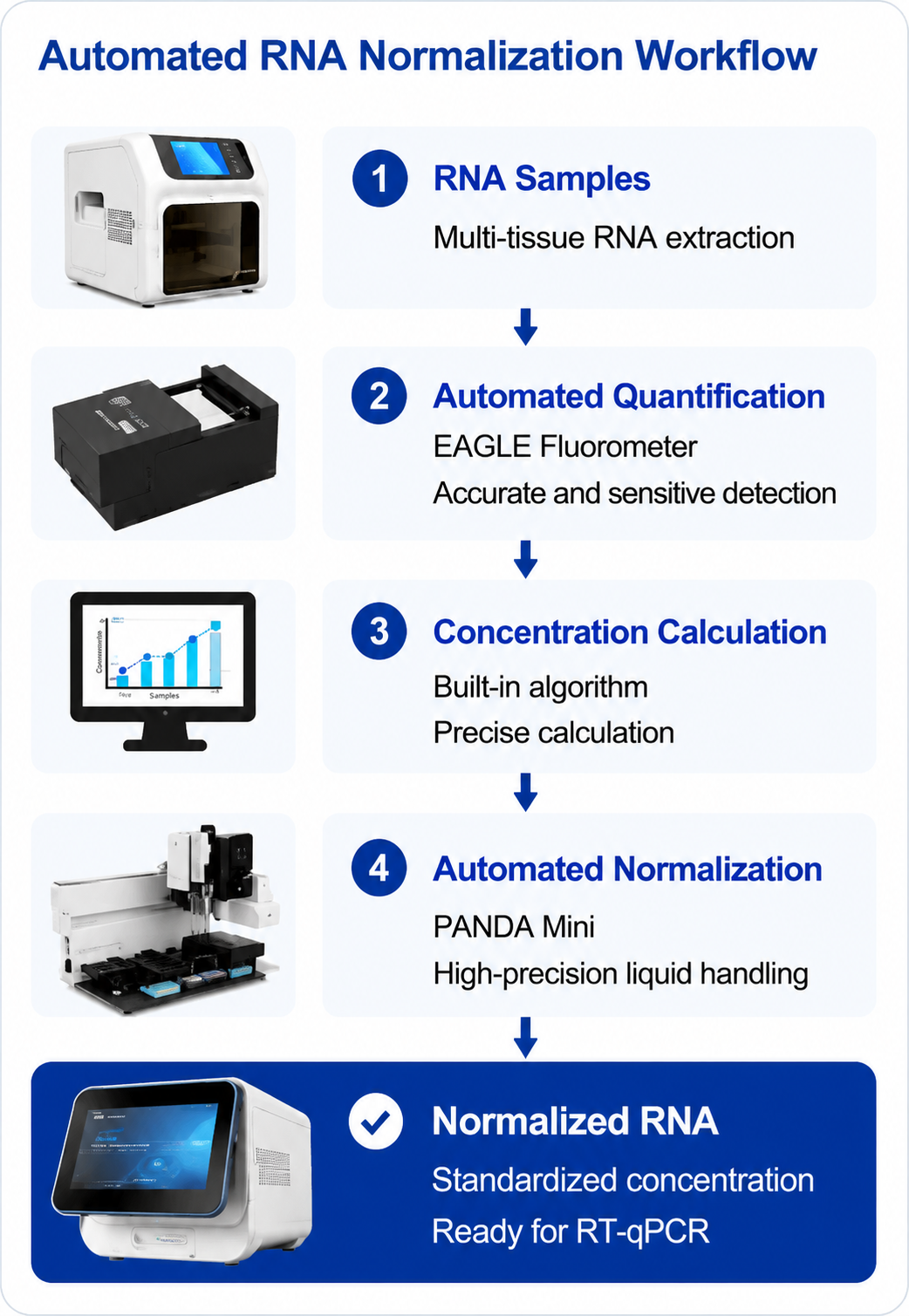
By combining EAGLE fluorescence quantification with precise liquid handling, PANDA MINI automatically calculates and adjusts sample volumes to achieve standardized RNA concentrations.
Key Benefits
High Throughput— Normalize up to 96 RNA samples per run
High Precision— Dilution accuracy CV < 10% for consistent normalization.
RNA Protection— Minimal hands-on time, reduced degradation risk
Standardized Inputs— Consistent RNA concentration for reliable RT-qPCR evaluation
2. NGS Workflow: Automated Normalization & Pooling
Key Challenge
Although extraction and library preparation have become increasingly automated, library normalization and pooling remain highly manual and time-consuming steps. Inaccurate balancing of libraries can lead to uneven sequencing output and inefficient data utilization.
Our Solution
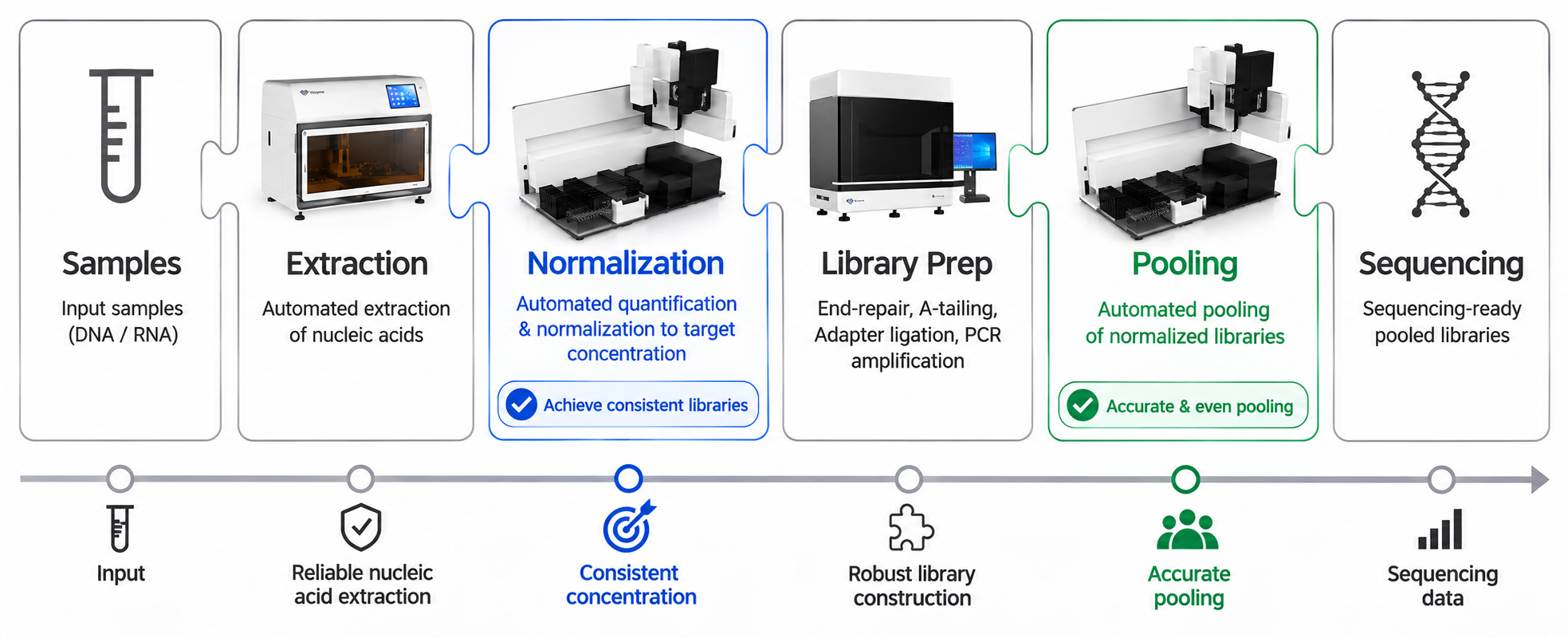
Through automated quantification-guided normalization and precise pooling, PANDA MINI ensures balanced library input before sequencing.
Key Benefits
Complete the NGS Workflow— Automate the completing normalization and pooling steps
Accurate Library Balancing— Achieve consistent library concentration and pooling ratio
Improved Sequencing Efficiency— Reduce variation caused by manual preparation
3. PCR & qPCR Setup Automation
Key Challenge
PCR and qPCR workflows require multiple repetitive pipetting steps, including dilution preparation, reagent dispensing, master mix addition, and sample transfer. Manual operation increases workload and the risk of experimental errors.
Our Solution
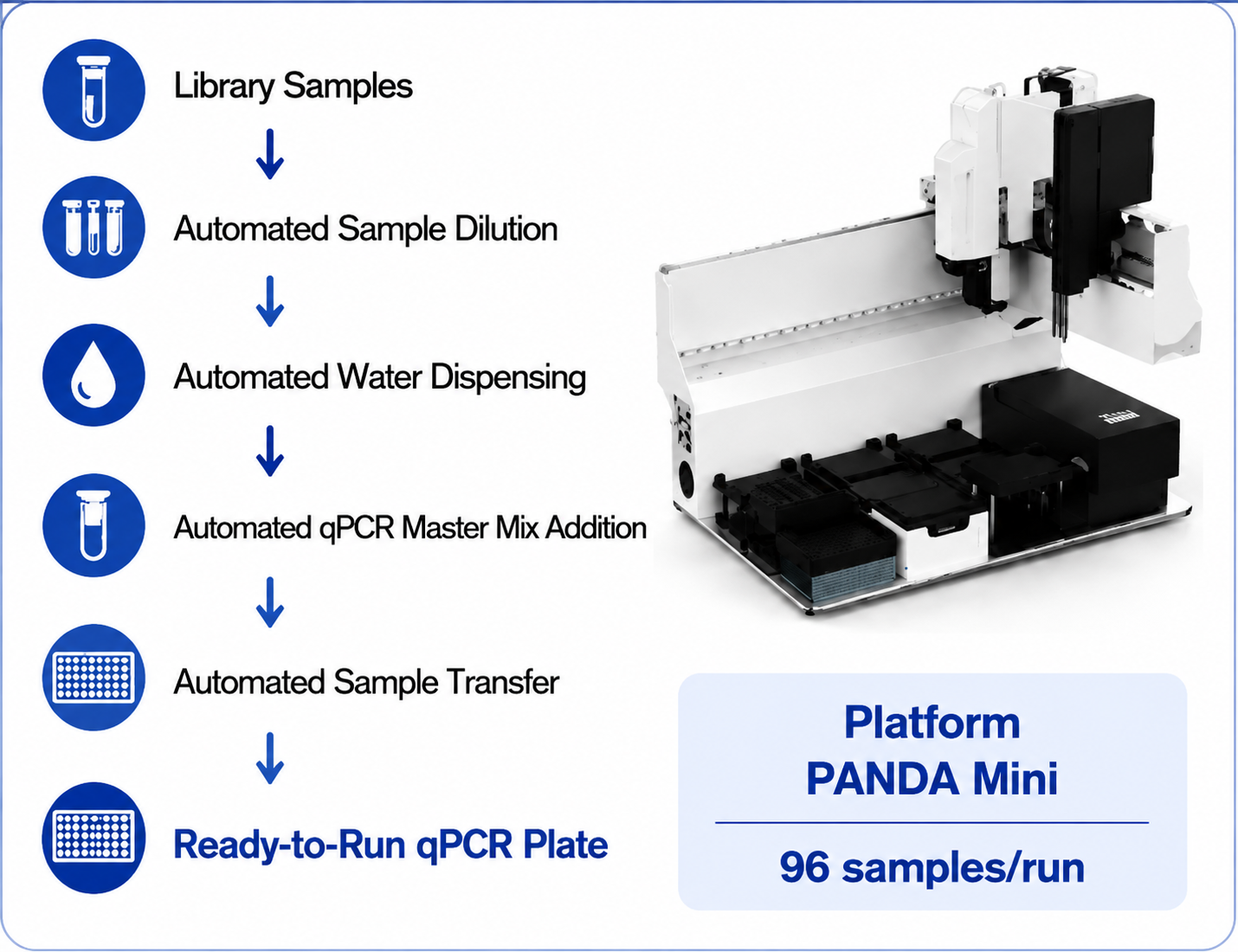
With precise multi-channel pipetting and flexible workflow configuration, PANDA MINI standardizes reaction setup and reduces manual intervention.
Key Benefits
Error Reduction— Minimize manual pipetting mistakes
Consistent Reaction Setup— Ensure accurate reagent distribution across wells
Integrated Solution— PANDA MINI is supported by dedicated reagent solutions to provide a complete and optimized qPCR setup workflow.